April 26: Clean up parks for Earth Day

This Saturday, April 26 from 8am to 12pm, you can be a part of the state’s first state park cleanup. Called “Keep It Clean Kansas,” it’s being organized by the Kansas Department of Wildlife Parks and Tourism and the Kansas Department of Health and Environment.

Five parks across the state are on this year’s cleanup list –keepitclean

  1. Cheney State Park, Cheney
  2. Clinton State Park, Lawrence
  3. Crawford State Park, Farlington
  4. Scott State Park, Scott City
  5. Tuttle Creek State Park, Manhattan

And the parks to be cleaned up for the event will rotate each year, so if your closest state park isn’t on this year’s list, it may be on next years.

If you’re interested in volunteering, register here. Volunteers get lunch and a t-shirt. It’s a great opportunity to get out and help play a part in the protection of the valuable natural resources in the state.


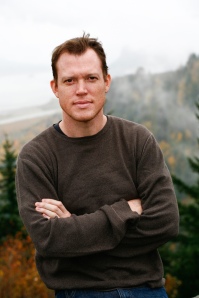
What’s so special about Kansas: Interview with Rolf Potts

Get off the paved roads and wander.

One of my favorite pastimes is hosting friends from the East or West Coast (or overseas), driving them through the landscape, and watching them react with joy to what they’d have missed had they been in a hurry.

As someone who dabbles in travel writing, I’ve known about Rolf Potts for a long time. He grew up in Kansas, and he’s spent time traveling the world and writing about it. His work has appeared in Salon.com, The New Yorker, The Atlantic, National Geographic Traveler, Outside and more.

His books include Vagabonding: An Uncommon Guide to the Art of Long-Term World Travel and Marco Polo Didn’t Go There: Stories and Revelations from One Decade as a Postmodern Travel Writer.

He’s also been in front of the camera for National Geographic Travel and the Travel Channel, and he teaches writing for Yale University and The Paris American Academy.

I reached out to him, and I have to admit a bit of a fangirl moment (I’ve read your books! I’ve wanted to do what you do!) when he replied quickly and was psyched to help with something Kansas related.

Kansas Trail Guide: Our book with University Press of Kansas is all about trails in Kansas for hiking, biking, and horseback riding.

Many of the trails are in state and county parks. Do you have a favorite park or favorite trail in Kansas? If so, what is it that makes it special for you?

Potts: I’m a fan of Kanopolis State Park. It’s not far from Saline County, where I keep a home, and I love the craggy, Smoky Hill landscape there.

Kansas Trail Guide: You’re known for your travel writing, particularly your book Vagabonding. I remember reading it when I was in college, and I remember being inspired to travel and to “get out” of Kansas.

With your experience as a travel writer, you could settle anywhere, but you still maintain a home in Kansas, which doesn’t seem as though it would be “exotic” or interesting for someone who’s seen the world. What brings you back to the state?

Potts: I’ve always had strong affection for my home state, and some of my best memories from childhood involve driving around to little-known corners of the state with my family while my father was doing biology research.

Interestingly, travel influenced my decision to come back to Kansas. In seeing how families drew strength and meaning from one another in distant corners of the globe, I made a decision to find a place close to my family. About nine years ago, my sister and her family had moved to a rural part of north-central Kansas, and she suggested I invest in some property and make my home base near her.

Less than two miles from her place we noticed that 30 beautiful acres of grassland, complete with two houses, was for sale. I couldn’t afford it myself, so I went in on it with my parents, who had recently retired. They moved into the big new house, while I spent a year and a half renovating the doublewide as my own prairie office.

Initially I think I saw this house as a place to linger between travels, but the more I invested in fixing it up, the more I spent time there, the more it began to feel like home on an intuitive level. The experience of vagabonding is something that deepens with experience, I think, and one way to give your travels added meaning over time is to cultivate some sense of home.

Kansas Trail Guide: What are some of the biggest Kansas misconceptions you think people have?

Potts: People tend to think that it’s flat and boring, or culturally backwards. But I think this is the opinion of people who either haven’t been here, or haven’t traveled slowly enough to appreciate the subtler gifts of a place like Kansas. One of my favorite pastimes is hosting friends from the East or West Coast (or overseas), driving them through the landscape, and watching them react with joy to what they’d have missed had they been in a hurry.

Kansas Trail Guide: For someone who’s never been to Kansas, do you have any recommendations for where to go or what to see?

Potts: My advice for non-Kansans is the same as my advice for Kansans: Get off the paved roads and wander. In most any county in the state, the best way to find landscape — and a sense giddy solitude — is to just find a dirt road and drive (or bike, or walk) until you find some completely surprising moment of beauty and epiphany.

Great Migration Rally this Sunday at Cheyenne Bottoms

As the weather warms up, migratory birds begin making their way back to and through Kansas. The state is on the Central Flyway, a migratory route between the Gulf of Mexico and central Canada. Some great spots to check out the birds are wetland and marsh areas, like Baker Wetlands near Lawrence, Quivira National Wildlife Refuge near Sterling, and Cheyenne Bottoms near Great Bend. Year round, you can check out Baker Wetlands and QNWR on foot with trails featured in the upcoming Kansas trails guidebook, and to explore Cheyenne Bottoms, you can go on a driving tour.

And in celebration of the spring migration, on Sunday, April 13, 2014 from 2pm to 7pm, Fort Hays State University’s Kansas Wetlands Education Center is hosting the Great Migration Rally.

You can see Kansas’ one and only falconer and his rescued Golden Eagle and you can take part in what’s essentially a scavenger hunt. From their website:

Participants start off by drawing a “bird” card, worth so many points. The rarer the species, the more points it is worth.

“Each bird is a species that migrates through Cheyenne Bottoms,” Curtis Wolf, KWEC manager, said.

After beginning their “migration”, driving through Cheyenne Bottoms, participants stop at three different points, picking up situational cards that describe a positive or negative circumstance. The positive cards, such as finding a good food source, add points. The negative cards, such as losing a wetland to development, subtract points. At the migration destination, Barton Community College’s Camp Aldrich, the migrants choose one last card, points are tabulated and those with the highest points win prizes…

…There are also crafts for kids and adults, with kids making a bird feeder to take home. In addition, Bird Bingo, bird tattoos and other activities will be available.

A comfort meal of ham, macaroni and cheese, green beans and biscuits will be served, with Tumnus, a trio from Wichita, providing Celtic and folk tunes.

If you go:

Cost for the event is $5 for adults, $2.50 for children ages 5-12 and free for children under age 5. Proceeds from the event to restoring monarch butterfly habitat, another species that wings its way through Kansas.

Participants are asked to pre-register by calling the KWEC, 1-877-243-9268, or emailing lkpenner@fhsu.edu, by April 6. More information is available at wetlandscenter.fhsu.edu.

Great Migration Rally


State Parks = Free this Saturday!

Plan on getting outdoors this Saturday, as all state parks will offer free admission and a variety of fun activities for visitors!  State parks are always one of the best deals for outdoor recreation, but you can’t beat free admission and activities available for all ages.

Get the party started with fishing derbies for the kids, prize drawings, fun runs, and even an Easter egg hunt at one of the parks.  If you’ve been waiting for spring to get started so that you can get back outside and savor the outdoor experience, there’s no better time than this Saturday to get back out and enjoy the parks.

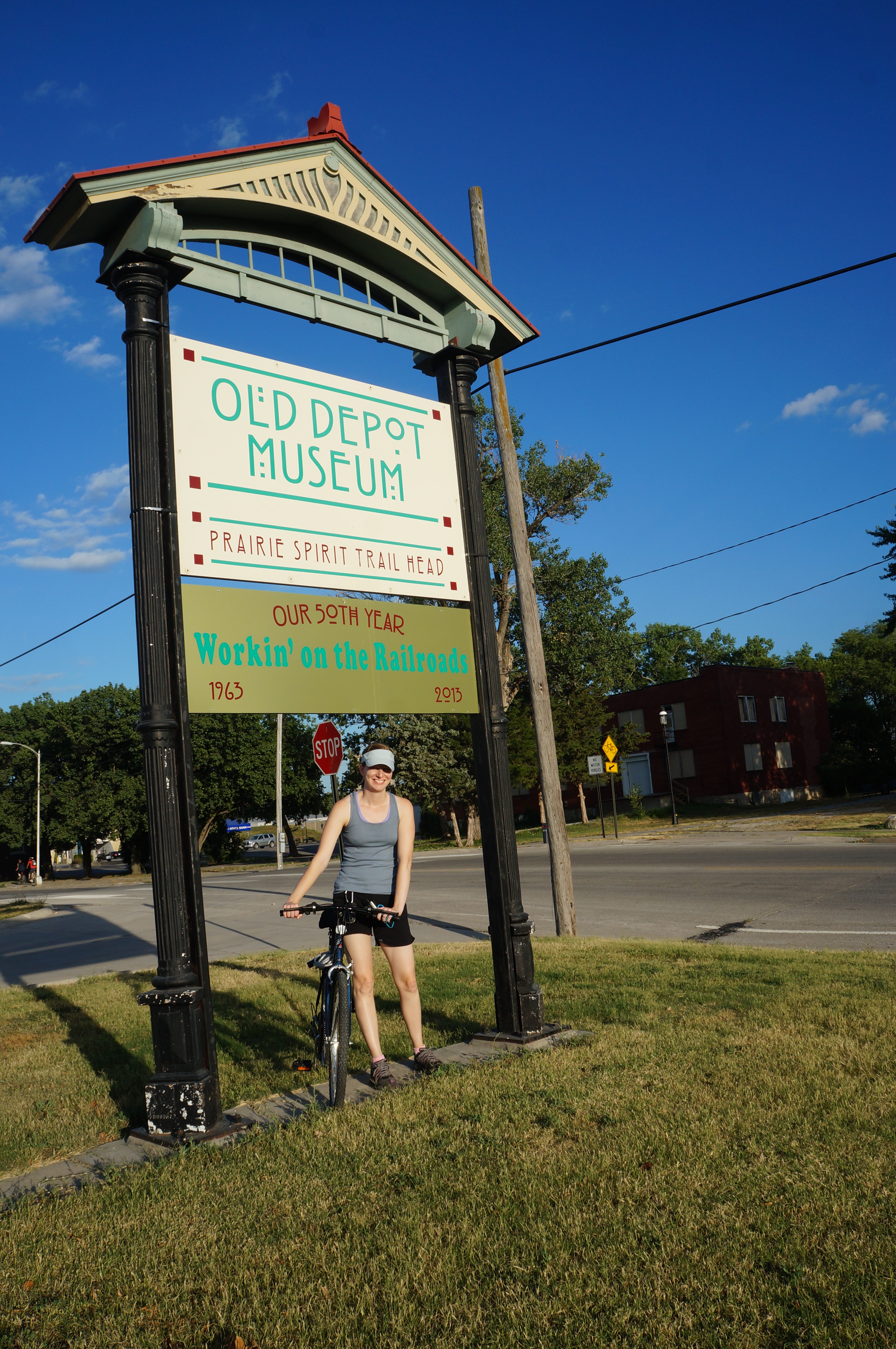
At the Ottawa trailhead for the Prairie Spirit Trail

At the Ottawa trail head for the Prairie Spirit Trail

Some of the highlights include:

El Dorado State Park – Nature Photography Hike (10:00 a.m.)

Perry Lake – Guided horse trail rides (Wild Horse Campground 10:30 and 11:30 a.m.)

Ottawa Depot – Prairie Spirit Trail – Bike or hike on the trail and enjoy a free lunch!

Tuttle Creek State Park – Nature Bird Hike (9:00 – 11:00 Meet at the park office)

Check out the full schedule of events to find out what is going on at a park near you.


Review of Wildflowers of the Great Plains app

As the weather warms up, wildflowers will start to bloom. Lots of Kansas trails have some spectacular wildflower displays along the way, and in the book, we will have a list of the best trails for wildlife/wildflower spotting. photo

While you’re out on the trail, you can carry along a book to help you identify the different plants and flowers, University Press of Kansas has a great field guide. Or, if you’re looking to use something you probably already have with you, your Android smart phone or iPhone, you can use an app.

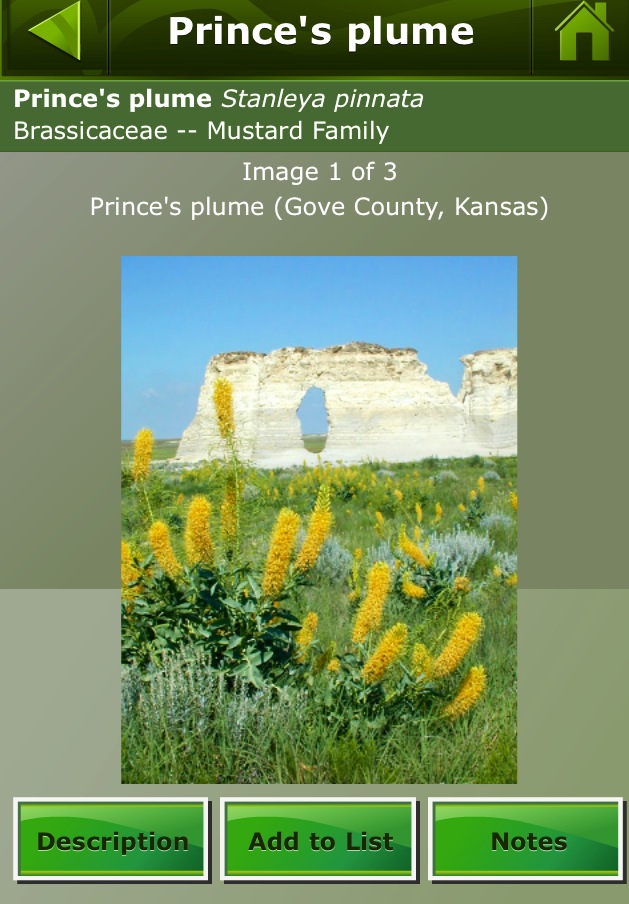
Written by the same author, Professor Michael John Haddock, who wrote the University Press of Kansas field guide, the Wildflowers of the Great Plains app is an easy to use, high tech way to ID plants and flowers in Kansas and the Great Plains. There’s a free version with 25 plants and flowers or for $3.99, you can check out over 500 species. You can search by location, habitat, flower color, or just browse by name.

Each flower or plant includes an image of it as well, with lots of the representative images from Kansas, like the Prince’s Plume here that’s in Gove County.

There’s also a quick section on plant morphology – flower parts, shapes, leaf attachments, etc. so in the description of the flower on the app, you can double check you know what you’re looking at out on the trail.

Bonus – the app works without cell signal, so you can still check out the flowers without having to be connected to the rest of the world.

What do you think of using technology out on the trail? And do you have a favorite Kansas wildflower? Let us know in the comments below.

Plant morphology

Ghost trails: 5 trails that have disappeared

Lake Atwood trail starts with such promise... Photo by Mark Conard

Lake Atwood trail starts with such promise… Photo by Mark Conard

A good guidebook should highlight the best of what’s out there.  However, it’s also important to know where not to go.  There’s nothing more disappointing than planning a trip and finding out that a trail is no longer used or is in poor condition.  We’ve done the work for you for the upcoming book, so you won’t end up on a trail that once was or isn’t anymore.

We would say rest in peace, but if we’re honest, we’d much rather these trails make a comeback with some loving care and, let’s face it, an infusion of cash.  Without further ado, here is our requiem to the “ghost trails” of Kansas:

1. Kingman State Fishing Lake / Byron Walker Wildlife Area – This hike was featured in the “Hiking Guide to Kansas” and is still listed online, and according to all descriptions seemed like it would be a great short hike.  It probably would have been a great hike. If it actually still existed.  Apparently trees fell across the trail during a large storm and it has never been cleared and rebuilt.  A few short years later there are few traces that it had ever existed.

2. Clark State Fishing Lake – Jay Wood Memorial Trail – After driving through the open croplands of western Kansas, the abrupt transition to the striking panorama of the steep canyonlands surrounding Clark State Fishing Lake is nothing short of breath-taking.  The excitement that was building to explore the  rugged terrain quickly dissipated when a park worker informed us that the trail bridge located shortly after the start of the trail had washed out and not been replaced.  The only remaining trace of the trail is a few steps in the banks leading down towards the stream where the bridge once stood.

This is what the bridge looked like before it washed out. . .  Photo by Jim Mason

This is what the bridge looked like before it washed out. . .
Photo by Jim Mason

Although there are no current plans to replace the trail, the spectacular scenery (and fishing possibilities!) makes this lake worth seeing. Just don’t expect to be able to go on the memorial trail.

3. Hayden Nature Trail at Lake Atwood – With great promise, this trail starts out wide and covered carefully in wood chips. Past a large observation tower that looks out over the currently dry lake bed, the trail hits the highway and peters out into nothing. It may have been a project started when the lake was being resealed in the mid 2000s and never finished.

4. Cimarron National Grassland – The eastern portion of the Turkey Trail – Between the Cottonwood Picnic Area and the Cimarron Campground, the trail is wide and easy south of the Cimarron River. Through stands of cottonwoods, it’s a mostly exposed trail that’s also open to ATVs along with mountain bikers and hikers. Once you get to the east side of Cimarron Campground, the trail fades. This is likely because east of the campground, the trail is off limits to ATVs. The end of the trail is one mile east of County Road 16, and since the terrain is relatively flat and treeless, you could probably make it to that end point from the campground, but it won’t be on a well-defined, easy to follow trail.

5. Honorable mention – Crawford State Fishing Lake – Drywood Creek Trail – This one is kind of there in spots, and it has enormous potential and it isn’t quite dead yet. It circumnavigates the lake, and dips in and out of the trees. Along the west side of the lake, the “trail” is the road along lake front cabins, and on the north side of the dam and on the east side of the lake, with washed out sections and fallen trees, the trail is hard to follow. At one point, I found myself trying to lift fallen trees myself to make sure I was mapping the “real” trail, but I realized that there was no way I’d want to recommend that particular route to anyone without some major cleanup.

Do you have fond memories of any of these trails? Have we gotten any of them wrong – have there been any improvements or updates to any of them? Let us know in the comments.

Flint Hills Nature Trail

Flint Hills Nature Trail

The woods are lovely, dark, and deep, But I have promises to keep, And miles to go before I sleep, And miles to go before I sleep.”  -Robert Frost

The long trail holds an allure unlike any other.  The good ones are the stuff of legend; the well-worn Appalachian Trail, rugged Continental Divide Trail, and Pacific Crest Trail are universally revered.  But the truly great long trails once cut through the endless expanse of prairie that we now call Kansas.  The names themselves are legendary; Oregon Trail, Santa Fe Trail, Chisholm Trail.  But all of these legends slowly died with the advent of the railroad.

There’s more than a bit of irony in the fact that well over a century later, the modern decline of the once wide-spread railroad has driven the establishment of the new long trails spanning the plains.  One of the best known trails in the Midwest is the acclaimed Katy Trail, which runs 225 east/west from St. Charles to Clinton, Missouri.

Kansas boasts multiple long rail-trails, including the Prairie Spirit Trail, Landon Nature Trail, Blue River Trail, and Meadowlark Trail.  However, the most ambitious rail-trails project is the Flint Hills Nature Trail.  When completed, this section of rail-trail will be the seventh longest in the nation and will stretch 117 miles from Osawatomie to Herington.  Currently, the trail is not fully open but there are many sections that are ready to ride.

Flint Hills Nature Trail

Flint Hills Nature Trail

Here’s a summary of our favorite sections that are open to explore:

Osawatomie to Ottawa (18.9 miles):  The easternmost section of the Flint Hills Nature Trail is well-maintained and easily accessible as it runs along the bluffs of the Marais De Cygne river east through Rantoul and on to the historic Old Depot Museum at Ottawa.  The depot also serves as the northern terminus for the Prairie Spirit Trail and is open for tours from March – December.

Vassar to Osage City (11.1 miles): To the west of Ottawa, the trail is intermittent with 1.2 miles open between the Old Depot Museum in Ottawa west to the Marais De Cygne River and a 2 mile finished stretch east of Pomona.  However, the longest continuous section along this part of the trail currently stretches from Vassar to Osage City.  Check out the unique assortment of merchandise at the Vassar Mercantile and enjoy the gradual downhill as you cross US-75 and continue on the trail west to Osage City.

Osage City to Council Grove (39.7 miles): From Osage City the trail runs west through Admire and Allen and enters the heart of the Flint Hills.  There are a few rough stretches but this entire section is certainly passable on foot or bike.  The section between Bushong and Council Grove is one of the most scenic and remote sections of the trail as it cuts through the rugged and vast Flint Hills landscape.

Wildflowers along the Flint Hills Nature Trail

Wildflowers along the Flint Hills Nature Trail

Before Council Grove a short side trip will take you to the Allegawaho Memorial Park just to the north of the trail.  This park is located on land that formerly served as the Kaw Indian Reservation.  The end of the trail is currently at Council Grove, once the last outpost of civilization for travelers heading west along the Santa Fe Trail.  While in Council Grove visit the Kaw Mission Historic Site and dine at the Hays House which has served fine food to weary travelers since 1857.

These sections of trail are some of our favorite, but we look forward to the completion of the trail which could occur as early as 2015.

3 adventures to check out this Valentine’s Day weekend

Happy Valentine’s Day! Since of course you don’t want to show your significant other how much they mean to you on just one day, stretch it out over at least the weekend with some of these three special opportunities:

Salt Safari Adventure in Hutchinson

Go underground on a unique tour of the Kansas Underground Salt Museum (3504 E. Avenue G, Hutchinson). It’s a 3-hour hike on February 15, 2014 through some of the unimproved caverns of the salt mine, perfect for adventure loving couples.

For tickets ($60) and more information: underkansas.org

The couple who runs together, stays together. Compete with a loved one in a 5K  run or go to cheer on the runners at the Ritz Carlton Plaza (9000 W. 137th, Overland Park) on February 6, 2014 at 9am.  Prizes go  fastest male, female or coed two person team in Kansas City. All runners will get custom finishers medals and long sleeve race shirts.

Dinner and a show: “Run For Your Wife”

Enjoy some laughs together over dinner with “Run For Your Wife” at the Historic Santa Fe Depot (201 E Wyatt Earp Blvd, Dodge City). The Dodge City based Depot Theater Company is taking on the story of a London cabbie who’s juggling two wives.

Tickets are $40 and the show starts at 7:30pm on February 14 and 15, 2014.

For more weekend options, check out the Kansas Calendar.

Photo by puamelia

Happy Valentine’s Day! Photo by puamelia


The answer is…

Tallgrass Prairie National Preserve

This schoolhouse is on Tallgrass National Prairie Preserve. Tallgrass prairie used to cover hundreds of millions of acres of land across the country. 4% of this unique and dynamic ecosystem remains, and much of that is in the Kansas Flint Hills. The preserve has a bison herd, a series of trails, and of course, the Lower Fox Creek School.

Photo by Mark Conard

Photo by Mark Conard

The Lower Fox Creek School was placed on the National Register of Historic Places on September 6, 1974. Made of local limestone, this one room schoolhouse saw its first class in the fall of 1884.

It was a “common school” – designed by Horace Mann, the schools were free, which meant families who hadn’t been able to afford school previously were able to get education for their children.

If you would like to check it out, it’s open weekends (Saturday and Sunday) from 12 p.m. – 4 p.m. in May, June, September, and October.

And for some fun, check out the rules for teachers (women must not loiter in town ice cream stores and men must not get shaved in a barber shop) and an 8th grade equivalency test that would have been taken at a school like this: School Rules and Tests.