How to Celebrate Earth Day 2015 in Kansas

Earth Day was first celebrated in 1970, it went global in 1990and the now annual event is one of the world’s largest civic events. On April 22, people around the world come together to raise awareness, show support for environmental issues, and to help make our planet cleaner and healthier.

From tree planting to clean ups to family fun, here are some ways you can get out and celebrate the 2015 Earth Day in Kansas (and one in Missouri).

April 18 at Sunset Zoo in Manhattan

Richard Renner & his Recycle Cycle will be there (you may have seen him at the Kansas State Fair) roaming the zoo. Plus there will be kid-friendly activities inside the Nature Exploration Center and story time with staff from the Manhattan Public Library, animal encounter tours led by the zoo’s animal ambassadors, and a zoo-wide scavenger hunt with prizes.

If you go:
Zoo open from 9:30am to 5pm; Earth Day activities from Noon to 4:30pm.
$5 adults, $3 children ages 3-12, 2 & under and FOSZ members free.
2333 Oak Street, Manhattan, KS

April 18 at Deanna Rose Children’s Farmstead in Overland Park

This turn of the century style family farm has plenty of animals along with flower and vegetable gardens, a fishing pond, and a one-room schoolhouse.

And for Earth Day, they’ll be hosting educational and entertaining programs about recycling, gardening, composting, and Kansas wildlife. There will be crafts, activities and events for the whole family.

If you go:
10am to 2pm
13800 Switzer Road, Overland Park
Free Mon.-Thurs.; $2/person Fri.-Sun. & Holidays/under 2 free

April 18 at Dillon Nature Center in Hutchinson

Snap up some good deals on perennial plants from 7:30 to 11:30am. Bird Watching 101 for families is from 8:30 to 9:30am, and you can learn about what birds to look out for on the trails around the nature center.

From 1-2 pm, The Hutchinson Public Library is hosting a “Wiggly Worms for Bookworms” – a story hour and project for kids 3-10.

If you go:
To register for the bird watching and the story telling (both free, but with limited availability), call 620-663-7411.
3002 E. 30th Avenue, Hutchinson, KS

April 22 at Powell Gardens in Kansas City

Free admission to Powell Gardens and free seedlings, while supplies last, to the early arrivals. They’ll also have a rain barrel raffle, guided tours, storytelling for the kiddos, and a display on up cycling.

If you go:
9am to 5pm
1609 N.W. U.S. Highway 50, Kingsville, MO

April 22 at Overland Park Arboretum in Overland Park

While not technically for Earth Day, it is held on Earth Day. You can become empowered to be a citizen scientist observer. The National Phenology Network will be holding a workshop to give attendees information on plant life cycles using the Arboretum’s trails and plants.

If you go:
Register online, $7 FOTA members, $10 non-members
8909 W 179th Street, Overland Park, KS

April 23 at the Sedgwick County Zoo in Wichita

Party for the Planet – free admission all day and an environmental fair with hands-on activities and exhibits geared for 3rd to 5th graders.

If you go:
Environmental fair is from 9am to 2pm and zoo open from 8:30am to 5pm.
5555 W Zoo Blvd., Wichita, KS

April 25 in Gardner

Gardner Parks and Recreation is hosting an Arbor and Earth Day event with a group cleanup of the Gardner Greenway Corridor – a paved trail that connects Winwood Park and Brookside Park. Then there’s a free barbecue lunch in the park. You can get in on the drawing for trees, t-shirts, and prizes and watch a tree planting demonstration.

RSVP by April 20 – call 913-856-0936.

If you go:
11am to 1pm at Gardener Greenway Corridor

Museum of World Treasures in Old Town Wichita

Museum of World Treasures. Photo by Mark Conard

Museum of World Treasures. Photo by Mark Conard

Where is the one place in the world where you can go to find a shrunken head, a mummy, a T-Rex, a piece of the Berlin Wall, and a pitchfork used in The Wizard of Oz? It’s the Museum of World Treasures in Old Town Wichita.

Ivan

Photo from Museum of World Treasures

Founded in 2001, it moved into its current location in the Farm and Art Market in Old Town in 2003. The exhibits showcase an eclectic and impressive range from millions of years of history with the centerpiece on the first floor – Ivan the T-Rex, and one of the most complete T-Rex discoveries in the world.

You can also check out exhibits on the World Wars, European royalty, Kansas paleontology, the Wild West, and more. You’ll definitely leave feeling more cultured than when you went in.

It’s the perfect place to take your kids – it’s not overly large, so you can see the entire museum without getting overwhelmed, and there’s a kids room with dress-up areas and toys and games. Throughout the museum, there are interactive exhibits perfect for kids.

About half of the treasures on exhibit come from the collection of the founders, Dr. Jon and Lorna Kardatzke, and the mix of artifacts is unexpected and delightful.

We went as a family for a birthday party, and the kids got a brief 20-minute themed tour – they learned about Ivan the dinosaur and cave bears! We also managed to time it with one of their Discovery Days.

The last Saturday of the month from 11am to 3pm, there are activity stations with games, crafts, and artifact exploration. Each month is different, and coming up there’s the St. Patrick’s Day Hats event on March 28 and The Greek Olympics on April 25.

They’ve got events for adults too. The Murder at the Museum: Deadwood Saloon event starts at 7pm on April 25, and you can dress up and play a part in the interactive murder mystery entertainment while enjoying snacks and drinks and exploring the museum. Tickets are $30 per adult or $25 for Museum Members. For $10 per child, bring children over 3 years old for an alternative kids program while the adults solve the crime.

If you go:MOWT

Mon-Sat: 10 a.m. – 5 p.m.
Sun: Noon – 5 p.m.

Family Day Pass (2 adults/2 children): $28.50
Adult: $8.95
Senior: $7.95Youth: $6.95
Children 3 and under are FREE!

To add to your trail book collection – Dirt Work and Wild

Although winter may not be relenting enough to hike, the upside is that there’s no better time to put your feet up, sip some hot chocolate, and enjoy a good trail book.  Here are two of our top picks to add to your trail anthology:

Dirt Work by Christina Byl

While normal hikers appreciate big views, wildflowers in bloom, or clouds drifting overhead, I must admit to spending a slightly inordinate amount of hiking time checking out the trail under my feet.  A good trail can do much to enhance the hiking experience, but the worst are prone to erosion or just generally boring hiking.  Each step of a well-built trail is carefully planned and constructed with a great deal of muscle and sweat.

Dirt Work

Without being on a crew (and I highly recommend the experience), it’s hard to get a sense for the art, science and just plain dirty work that goes into building an excellent trail.  In “Dirt Work”, Christina Byl recounts her journey from a rookie crew member building alpine trails in Glacier National Park to a crew leader calling the shots in the wilderness of Alaska.

Byl has vast experience working on trail crews and she accurately portrays the “work hard, play hard” experience of the traildog life.  The book rolls the dirt and the glory of trail-building into a fascinating and insightful assessment into the proud blue-collar world behind your favorite trail and will leave you yearning to spend a summer cutting tread in the high country.


Wild by Cheryl Strayed

With a life unraveling and out of control, Cheryl Strayed undertakes an ambitious hike to try to make sense of it all. wildAnd by rather ambitious I mean she merely sets out to hike the majority of the Pacific Crest Trail.  Solo.  Of course she has scant experience, a pack much too big, and boots painfully too small.  Despite this prescription for epic failure she perseveres and chronicles the drudgery, pain, and elation of life on the long trail in wonderful detail.

In my experience, time in the woods alone brings a sense of perspective and clarity to life, and after months on the trail Strayed works through the crucible and comes out on the other side a truly different person.

African-American History and its links to Kansas trails

February is Black History Month, and Kansas has connections to the Civil War and Civil Rights that also tie in with some of our state’s trails.

Bleeding Kansas

In the 1850s and early 1860s, Kansas Territory was in a series of skirmishes with neighboring Missouri. The battles were so intense, they earned the nickname Bleeding Kansas or Bloody Kansas. The focus of these fights was, primarily, slavery. A few months before the Civil War officially began (some say the first shots of the Civil War were at what is now Black Jack Battlefield), Kansas entered the Union as a free state. You can walk along trails through the historic Black Jack Battlefield – featured as a top history trail in our Kansas Trail Guide.

Nicodemus Visitor's Center. Photo by Mark Conard

Nicodemus Visitor’s Center. Photo by Mark Conard

Nicodemus

Kansas was the “promised land” for newly freed slaves, and the town of Nicodemus was created in 1877 as a refuge. It was the first black community west of the Mississippi. While the town’s population fell after the railroad didn’t make it a stop, the community still survives. You can take a self-guided tour of the National Historic Site where some of the original buildings still stand.  From the National Park Service:

The land on which Nicodemus and other black communities stood in Kansas was not the most advantageous for agriculture, and natural drought cycles frustrated efforts to raise crops. Even so, in the decades following the Civil War, this part of the West offered African Americans a chance at a life usually unobtainable in much of the South. The courage and spirit that motivated African Americans to leave their homes and move to the Midwest after the Civil War to places like Nicodemus also helped propel them toward equality of opportunity in Brown v. Board of Education of Topeka, Kansas roughly a century later.

The small town is less than a 15-minute drive from Webster State Park. The Coyote Trail in the park feature signs and interpretive information that can help you learn more about the flora and fauna of the area.

Brown v Board of Education

With Brown v Board of Education, racially segregated public schools became officially determined as unconstitutional. It was clearly a complicated time for race relations, as the Board of Education was pro-segregation, and a group of Topeka parents advocating for their children had to take the issue to the United States Supreme Court. You can visit the Brown v Board of Education site at 1515 SE Monroe Street, Topeka, KS, 66612. This national historic site is free to visit, and it is in the location of the former all black Monroe school. Inside is a series of exhibits on the history of racism, segregation, education, and justice in the state and the country. And it’s the start of the Landon Nature Trail, a 38-mile rail trail that will connect the Shunga Trail in Topeka to the 117-mile Flint Hills Nature Trail.

Kansas turns 154 this Thursday – here’s where to celebrate

Kansas Day is January 29, and this year, Kansas turns 154! In its 154th year, you’ll be able to explore via its miles upon miles of trails from prairies to woodlands with our trail guide.

More immediately, from the Kansas tourism site, here are some upcoming Kansas Day events for 2015.

To celebrate Kansas’ 154th birthday, the Kansas Historical Society in Topeka plans a full day of performances and activities to celebrate Kansas’ 154th birthday. Exhibit: The Great Soldier State: Kansas and the Civil War.

Paola’s Kansas Day & Business Expo will feature entertainment, children’s activities, local products, food vendors, and more than 75 business and organization exhibits.

On Sat., Jan. 31, 2015, Burlington’s Coffey County Historical Society & Museum will feature activities for kids, a chili feed, and live and silent auctions.

Kansas Day Celebration at Kauffman Museum in Newton on January 31 is a free event featuring wagon rides, popcorn popping over an open fire, make-it-take-it crafts and much more!

What will you be doing for Kansas Day?

KanStarter: Crowd-funding for Kansas towns

What do a putt-putt golf course, an opera house, a trail archway, and a grocery store have in common? They’re all pilot projects for KanStarter.

Crowd-funding on websites like IndieGoGo and Kickstarter have become popular, and now you can help support a home-town project via KanStarter. Donate money, and occasionally supplies, to help make small town and rural destinations shine.

Marci Penner of the Kansas Sampler Foundation came up with the idea, inspired by the idea that many people in small towns didn’t think they had anything worth including in a guidebook, and tax credits helped get the site up and running.

The project launched as a part of the We Kan Network, a nonprofit that works with the Kansas Sampler Foundation to “preserve and sustain rural culture.”

The minimum donation is $1 and there are time limits to the project funding. There are four pilot projects currently up for funding, and projects can be submitted for consideration on the website.

The four pilot projects are the Opera House Revival: Let It Sing! in Wilson, the South Owl Lake Trail Archway in Yates Center (check out the video below), Rediscover Pluto Putt-Putt in Burdett, and Help Get Dirt for a grocery store in Plains.

The idea that Kansas, and particularly rural Kansas, doesn’t have much in the way of tourism or attractions is one that I’ve frequently come across in work on the trail guide and as I’ve traveled throughout the state and throughout the country. There may not be the State of Liberty or a soaring mountain range, but there is history, art, culture, and natural beauty that is worth getting to know.

And it was touching to see that two of the projects currently up for funding on KanStarter are in small towns that I know because I have family who lived there. They’re places I visited frequently as a child and still go to today. They are places worth being proud of and projects worth supporting.

2015 Symphony in the Flint Hills Location Announced

2014 Symphony in the Flint Hills

2014 Symphony in the Flint Hills

On June 13, 2015, the Symphony in the Flint Hills is coming home!

For the 10th anniversary of the event, it will be held at the Tallgrass Prairie National Preserve.

From the Symphony in the Flint Hills site:

We are thrilled to celebrate the 10th anniversary of the Symphony in the Flint Hills Signature Event back where it all started at the Tallgrass Prairie National Preserve,” said Jim Hoy, Board Chair for Symphony in the Flint Hills, Inc. “Our milestone anniversary and this historic location lend themselves to help us further our mission of heightening appreciation and knowledge of the tallgrass prairie. We plan to take it a step further with the theme, ‘Grasslands of the World,’ and The Nature Conservancy as our partner for the education programs.”

What’s so special about Kansas: Interview with A Kansas Bestiary authors and artist

As a part of our what’s so special about Kansas series, we reached out to the authors and artist of A Kansas Bestiary. Read our review of the book here and read on for their thoughts about what makes Kansas so special.bestiary_cover_t180
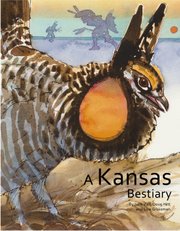
A bit about them from their website: Jake Vail lives in the Wakarusa watershed and works as a librarian in Lawrence, Kansas. Doug Hitt holds an M.A. in Earth Literacy and has studied with eco-philosopher Joanna Macy. Lisa Grossman is a painter and printmaker in Lawrence, Kansas, whose work focuses on the wide skies, prairies, and river valleys of Kansas.

Kansas Trail Guide: Our book with University Press of Kansas is all about trails in Kansas for hiking, biking, and horseback riding.

Many of the trails are in state and county parks. Do you have a favorite park or favorite trail in Kansas? If so, what is it that makes it special for you?

JV: I’d pick the long loop at Konza Prairie (my first exposure to the Flint Hills), and the Tallgrass Prairie National Preserve. Doug and I went for a two-day meander on the trails there during the writing of A Kansas Bestiary. From free-ranging bison to box turtles to scissor-tailed flycatchers and the great surprise of prairie chickens booming in the evening, it turned out to be a Kansas highpoint.

But remember that almost all of the state is private land. I’ve been fortunate to get to know some farmers and ranchers and see sides of Kansas that many people haven’t. We need more parks! (And “we” includes the critters.)

DH: My favorite trails are in the Tallgrass Prairie National Preserve near Strong City. The open vista of horizon and multi-hued flora, the breezy soundscape punctuated with insect hum and sparrow call unleash me from too-much-thought.
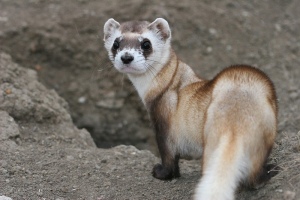
Photo by J. Michael Lockhart/USFWS

Black-footed ferret. One of the animals in A Kansas Bestiary. Photo by J. Michael Lockhart/USFWS

LG: By far, the trails I frequent most in all seasons for biking, hiking and foraging are the Kansas River Trails along the Kansas River in Lawrence. These start at the 8th St. boat ramp and wind eastward through the woods for a total of 13 miles (- I think) Experiencing them on an almost every-other-day basis allows me to feel the subtle and sometimes dramatic shifts in weather and season.

But for sheer inspiration and grandeur I’ll choose the main trail into the back country of the Tallgrass Prairie Preserve. It only takes about a mile of hiking to get yourself into the most vast, quiet expanse of prairie with very few obstructions on the horizon, which is so rare. You can really lose yourself there with a few miles of easy walking. Plus there are bison and it’s open 24 hrs.

Kansas Trail Guide: What inspired the writing of A Kansas Bestiary?

JV: Indirectly, moving to Kansas and then realizing so many people fail to appreciate it – here and elsewhere. More directly, Barry Lopez’s essays and Rebecca Solnit and Mona Caron’s A California Bestiary.

DH: The impetus for writing the Bestiary actually came from Rebecca Solnit and Mona Caron’s book, A California Bestiary; but, the actual inspiration–the driving force–came from the deep pleasure of encountering the creatures that we had chosen to honor.

LG: This is Jake and Doug’s to answer!

Kansas Trail Guide: What are some of the biggest Kansas misconceptions you think people have?

JV: That the opening scene of the Wizard of Oz portrays Kansas accurately.

DH: Foremost, the Great Plains are “plain.”

LG: That it’s big and empty.

Kansas Trail Guide: Out of staters often think of Kansas as “flyover country” – what would you say to change their minds?

JV: It wouldn’t change minds, but the history of Euramerican travel here is instructive. After Coronado and Zebulon Pike, eyes on a particular prize, both got lost, Kansas became “walk-over country,” to get most directly to the markets of Santa Fe, the green fields of Oregon, and the gold fields of California and Colorado. Now we drive the interstates (which started near Topeka, thanks to a Kansan) or move from big airport to big airport. Really, what isn’t flyover country?

DH: All ecoregions have their unique language. Some, the front range of Colorado for instance, shout grandeur. Others are quieter, more courteous, subtle. Attuning ourselves to the latter is a deep pleasure akin to reading haiku.

LG: Spend a few nights in the Flint Hills. That should do it.

Kansas Trail Guide: For someone who’s never been to Kansas, do you have any recommendations for where to go or what to see?

JV: If you’re interested in the bestiary, you’d be interested in the fairly new Flint Hills Discovery Center in Manhattan and the Wetlands Education Center at Cheyenne Bottoms. But mainly I’d recommend getting onto the back roads, and striking out on foot and taking time to explore.

DH: Tallgrass National Preserve, Cheyenne Bottoms, Quivira Refuge.

Sunset at Quivira National Wildlife Refuge. Photo by Mark Conard

Sunset at Quivira National Wildlife Refuge. Photo by Mark Conard

LG: I’d like to suggest different criteria for exploring Kansas. I’d ask you to seek out places rich in biodiversity, a natural silence, and the widest spans of unimpeded horizon you can find. If you find a place with all three it’s a treasure indeed.

Kansas Trail Guide: For someone who grew up in Kansas and feels like they’ve seen everything there, do you have any recommendations for where to go or what to see?

JV: Following Heraclitus, I believe you can’t step into the same Kansas twice. Visit a favorite place in all seasons, from different directions, in all kinds of weather, day and night, for a short time or a long time, and it will be different every time.

DH: I am one of these people! When I find local lodging in small towns like Council Grove, Herrington, Stafford and then spend several days attuning to the nearby wild areas, I experience unexpected adventure. The key word is “expectations.” How do these cause us to dismiss or minimize what is right before us? “Plain” is a state of mind.

LG: I’m from Pennsylvania and didn’t come to Kansas City until 1988, and I wondered where I could find the prairies. Local friends directed me to the Flint Hills and that changed everything for me. The open expanses and vast skies became my inspiration and vocation. Luckily, PrairyErth was published right after I got here so that deepened my understanding and appreciation for exploring the Flint Hills initially.

As I’ve lived here over 25 years now, I’ve come to appreciate the waterways, especially the Kansas River, where I’ve kayaked and encountered a whole new side of Kansas––170 miles of the Kansas Water Trail – all open to the public for recreation with boat ramps nearly every 10 miles. It’s fabulous.

Kansas Trail Guide: What makes Kansas special for you?

JV: It boils down to open skies and the frequent surprise.

DH: Expansive horizons, the subtle play of light on cloud and grass, the stormy intersection of high and low pressure zones.

LG: Especially as an artist, I can use the fact that Kansas is largely under-appreciated to challenge myself to convey the immense beauty I find here to those who don’t see it. Places like Santa Fe or Sedona are so obviously beautiful that there are 1000’s of artists there and I would find that a much more difficult situation!

The space itself is what I revel in here. My work invites folks to slow down and take the long way–to stop long enough to see which way the clouds are moving, how the light changes, to sharpen their awareness and senses to the place.


The delicious and the disgusting at the State Fair

There’s nothing quite like fair food. Deep fried or slathered in sugar or doused in sauce or on a stick or sometimes all of the above. There’s even a new competition this year at the Kansas State Fair – best food on a stick. Will your favorite treat get the prize? Results will be in in a week.

Photo by churl han

Photo by churl han

Classics (and our personal favorites – we’re state fair purists) include giant turkey legs, funnel cakes, chicken and noodles, and Pronto pups. I’m scared to see the size of the turkey that results in a turkey leg that’s as big as my face, but it sure is tasty.

Other “delicacies” that make the cut for worth trying and have been around for a few years – deep fried peaches and twisted potatoes.

We tried the “moo-ink” which, as I recall (I may have blocked the memory from my mind) was a bacon wrapped meatball covered in barbecue sauce and served on a stick. I remember it being…too much. Fried Oreos – the Oreo is so delicious on its own, why would you degrade it by dunking it in oil? Deep fried cheesecake? Same question.

Some newcomers to the Kansas fair food scene this year include deep fried Nutella, deep fried Jello (tried to get it last year, but they’d sold out), and chicken rolled in Frosted Flakes and fried (oh, and it’s on a stick).

There will also be toasted ravioli, which sounds amazing, and homemade sodas.

What’s your favorite fair food? Let us know in the comments!