KanStarter: Crowd-funding for Kansas towns

What do a putt-putt golf course, an opera house, a trail archway, and a grocery store have in common? They’re all pilot projects for KanStarter.

Crowd-funding on websites like IndieGoGo and Kickstarter have become popular, and now you can help support a home-town project via KanStarter. Donate money, and occasionally supplies, to help make small town and rural destinations shine.

Marci Penner of the Kansas Sampler Foundation came up with the idea, inspired by the idea that many people in small towns didn’t think they had anything worth including in a guidebook, and tax credits helped get the site up and running.

The project launched as a part of the We Kan Network, a nonprofit that works with the Kansas Sampler Foundation to “preserve and sustain rural culture.”

The minimum donation is $1 and there are time limits to the project funding. There are four pilot projects currently up for funding, and projects can be submitted for consideration on the website.

The four pilot projects are the Opera House Revival: Let It Sing! in Wilson, the South Owl Lake Trail Archway in Yates Center (check out the video below), Rediscover Pluto Putt-Putt in Burdett, and Help Get Dirt for a grocery store in Plains.

The idea that Kansas, and particularly rural Kansas, doesn’t have much in the way of tourism or attractions is one that I’ve frequently come across in work on the trail guide and as I’ve traveled throughout the state and throughout the country. There may not be the State of Liberty or a soaring mountain range, but there is history, art, culture, and natural beauty that is worth getting to know.

And it was touching to see that two of the projects currently up for funding on KanStarter are in small towns that I know because I have family who lived there. They’re places I visited frequently as a child and still go to today. They are places worth being proud of and projects worth supporting.

2015 Symphony in the Flint Hills Location Announced

2014 Symphony in the Flint Hills

2014 Symphony in the Flint Hills

On June 13, 2015, the Symphony in the Flint Hills is coming home!

For the 10th anniversary of the event, it will be held at the Tallgrass Prairie National Preserve.

From the Symphony in the Flint Hills site:

We are thrilled to celebrate the 10th anniversary of the Symphony in the Flint Hills Signature Event back where it all started at the Tallgrass Prairie National Preserve,” said Jim Hoy, Board Chair for Symphony in the Flint Hills, Inc. “Our milestone anniversary and this historic location lend themselves to help us further our mission of heightening appreciation and knowledge of the tallgrass prairie. We plan to take it a step further with the theme, ‘Grasslands of the World,’ and The Nature Conservancy as our partner for the education programs.”

What’s so special about Kansas: Interview with A Kansas Bestiary authors and artist

As a part of our what’s so special about Kansas series, we reached out to the authors and artist of A Kansas Bestiary. Read our review of the book here and read on for their thoughts about what makes Kansas so special.bestiary_cover_t180
A bit about them from their website: Jake Vail lives in the Wakarusa watershed and works as a librarian in Lawrence, Kansas. Doug Hitt holds an M.A. in Earth Literacy and has studied with eco-philosopher Joanna Macy. Lisa Grossman is a painter and printmaker in Lawrence, Kansas, whose work focuses on the wide skies, prairies, and river valleys of Kansas.

Kansas Trail Guide: Our book with University Press of Kansas is all about trails in Kansas for hiking, biking, and horseback riding.

Many of the trails are in state and county parks. Do you have a favorite park or favorite trail in Kansas? If so, what is it that makes it special for you?

JV: I’d pick the long loop at Konza Prairie (my first exposure to the Flint Hills), and the Tallgrass Prairie National Preserve. Doug and I went for a two-day meander on the trails there during the writing of A Kansas Bestiary. From free-ranging bison to box turtles to scissor-tailed flycatchers and the great surprise of prairie chickens booming in the evening, it turned out to be a Kansas highpoint.

But remember that almost all of the state is private land. I’ve been fortunate to get to know some farmers and ranchers and see sides of Kansas that many people haven’t. We need more parks! (And “we” includes the critters.)

DH: My favorite trails are in the Tallgrass Prairie National Preserve near Strong City. The open vista of horizon and multi-hued flora, the breezy soundscape punctuated with insect hum and sparrow call unleash me from too-much-thought.
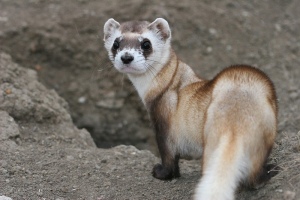
Photo by J. Michael Lockhart/USFWS

Black-footed ferret. One of the animals in A Kansas Bestiary. Photo by J. Michael Lockhart/USFWS

LG: By far, the trails I frequent most in all seasons for biking, hiking and foraging are the Kansas River Trails along the Kansas River in Lawrence. These start at the 8th St. boat ramp and wind eastward through the woods for a total of 13 miles (- I think) Experiencing them on an almost every-other-day basis allows me to feel the subtle and sometimes dramatic shifts in weather and season.

But for sheer inspiration and grandeur I’ll choose the main trail into the back country of the Tallgrass Prairie Preserve. It only takes about a mile of hiking to get yourself into the most vast, quiet expanse of prairie with very few obstructions on the horizon, which is so rare. You can really lose yourself there with a few miles of easy walking. Plus there are bison and it’s open 24 hrs.

Kansas Trail Guide: What inspired the writing of A Kansas Bestiary?

JV: Indirectly, moving to Kansas and then realizing so many people fail to appreciate it – here and elsewhere. More directly, Barry Lopez’s essays and Rebecca Solnit and Mona Caron’s A California Bestiary.

DH: The impetus for writing the Bestiary actually came from Rebecca Solnit and Mona Caron’s book, A California Bestiary; but, the actual inspiration–the driving force–came from the deep pleasure of encountering the creatures that we had chosen to honor.

LG: This is Jake and Doug’s to answer!

Kansas Trail Guide: What are some of the biggest Kansas misconceptions you think people have?

JV: That the opening scene of the Wizard of Oz portrays Kansas accurately.

DH: Foremost, the Great Plains are “plain.”

LG: That it’s big and empty.

Kansas Trail Guide: Out of staters often think of Kansas as “flyover country” – what would you say to change their minds?

JV: It wouldn’t change minds, but the history of Euramerican travel here is instructive. After Coronado and Zebulon Pike, eyes on a particular prize, both got lost, Kansas became “walk-over country,” to get most directly to the markets of Santa Fe, the green fields of Oregon, and the gold fields of California and Colorado. Now we drive the interstates (which started near Topeka, thanks to a Kansan) or move from big airport to big airport. Really, what isn’t flyover country?

DH: All ecoregions have their unique language. Some, the front range of Colorado for instance, shout grandeur. Others are quieter, more courteous, subtle. Attuning ourselves to the latter is a deep pleasure akin to reading haiku.

LG: Spend a few nights in the Flint Hills. That should do it.

Kansas Trail Guide: For someone who’s never been to Kansas, do you have any recommendations for where to go or what to see?

JV: If you’re interested in the bestiary, you’d be interested in the fairly new Flint Hills Discovery Center in Manhattan and the Wetlands Education Center at Cheyenne Bottoms. But mainly I’d recommend getting onto the back roads, and striking out on foot and taking time to explore.

DH: Tallgrass National Preserve, Cheyenne Bottoms, Quivira Refuge.

Sunset at Quivira National Wildlife Refuge. Photo by Mark Conard

Sunset at Quivira National Wildlife Refuge. Photo by Mark Conard

LG: I’d like to suggest different criteria for exploring Kansas. I’d ask you to seek out places rich in biodiversity, a natural silence, and the widest spans of unimpeded horizon you can find. If you find a place with all three it’s a treasure indeed.

Kansas Trail Guide: For someone who grew up in Kansas and feels like they’ve seen everything there, do you have any recommendations for where to go or what to see?

JV: Following Heraclitus, I believe you can’t step into the same Kansas twice. Visit a favorite place in all seasons, from different directions, in all kinds of weather, day and night, for a short time or a long time, and it will be different every time.

DH: I am one of these people! When I find local lodging in small towns like Council Grove, Herrington, Stafford and then spend several days attuning to the nearby wild areas, I experience unexpected adventure. The key word is “expectations.” How do these cause us to dismiss or minimize what is right before us? “Plain” is a state of mind.

LG: I’m from Pennsylvania and didn’t come to Kansas City until 1988, and I wondered where I could find the prairies. Local friends directed me to the Flint Hills and that changed everything for me. The open expanses and vast skies became my inspiration and vocation. Luckily, PrairyErth was published right after I got here so that deepened my understanding and appreciation for exploring the Flint Hills initially.

As I’ve lived here over 25 years now, I’ve come to appreciate the waterways, especially the Kansas River, where I’ve kayaked and encountered a whole new side of Kansas––170 miles of the Kansas Water Trail – all open to the public for recreation with boat ramps nearly every 10 miles. It’s fabulous.

Kansas Trail Guide: What makes Kansas special for you?

JV: It boils down to open skies and the frequent surprise.

DH: Expansive horizons, the subtle play of light on cloud and grass, the stormy intersection of high and low pressure zones.

LG: Especially as an artist, I can use the fact that Kansas is largely under-appreciated to challenge myself to convey the immense beauty I find here to those who don’t see it. Places like Santa Fe or Sedona are so obviously beautiful that there are 1000’s of artists there and I would find that a much more difficult situation!

The space itself is what I revel in here. My work invites folks to slow down and take the long way–to stop long enough to see which way the clouds are moving, how the light changes, to sharpen their awareness and senses to the place.

The answer is…

Prairie Sunset Trail near Wichita. The Prairie Sunset Trail runs from Goddard to Garden Plain, with eventual plans to add another 4 miles to Wichita. The one-way trail between 295th Street W. and 167th Street W. can be taken in either direction. 

The covered bridge near the Garden Plain trailhead is a memorial for Cecile Kellenbarger, a cyclist and longtime trail volunteer.

It was dedicated on July 4, 2012, to commemorate her passion for the trails of Kansas.


Review of Garmin GPSMAP 64s

photo-1

GPSMAP 64s

The time has come to review another Garmin GPS device. First we had the eTrex Legend, then the Oregon 650t and now we have the GPSMAP 64s ($399).

Things to love about it:

Comes with a basemap that you could still use to follow your own track and you get a free regional 24K topo map that you can download via your computer.

Uses GPS satellites as well as Russian GLONASS satellites, which means that in heavy tree cover or canyons, you still get a signal.

Screen is sunlight readable and can be brightened or darkened – darker gives you more battery life.

Can be connected to your computer via USB and tracks can be transferred via BaseCamp.

Waterproof and durable.

It’s a handheld device that also comes with a way to carabiner/clip it to your bag or a mount to put on a bike.

Great at determining elevation with a barometric altimeter (though, frankly, in Kansas, this isn’t as much of a concern) and electronic compass gives good bearings on which way you’re facing, even if you’re not holding the device level.

Want to know when you’re within .05 to 250+ miles of a certain spot? You can set a proximity alarm for different locations that you can set before you leave or at the car.

It can be synced with Bluetooth and you can also link it to get text notifications if you pair it to your iPhone (apparently – I didn’t try it because I didn’t want alerts on the trail).

You can wirelessly send and receive data with other GPS devices.

It gives you sun/moon data – daylight hours left are important to know, and you won’t miss sunrise.

Thousands upon thousands of preloaded geocaches that you can check off, if you’re into that kind of thing.

Things be aware of:

Official waterproof testing

Official waterproof testing

My main annoyance was that there wasn’t a touch screen (I’m used to touch screens, though my slightly more Luddite brother was a fan of the buttons from the start).

But as I did some thinking about it, it’s easier to use buttons if you have on gloves or if it’s raining. So it may take some getting used to for those more accustomed to smart phones, but I think it’s something work getting used to.

It doesn’t have a camera.

Another thing to consider is the mapping. With the 64s, the topographic maps don’t come loaded, though it does come with the option to get one region of 24K topo maps for free as well as the option to buy more.

If you want maps preloaded, you can get GPSMAP 64st, which comes with 100K topo maps (not as great a resolution as the 24K, but for Kansas, which has relatively little elevation concerns, 100K is fine) and that will cost you an extra $100.

For $100 less than the 64s, at $299, you can get the Garmin GPSMAP 64, with that you lose the wireless connection and the barometric altimeter and the triaxial compass, so you have to hold it level to get an accurate reading.

Final thoughts:

Take some time to play with it before you head out on the trail, download your free 24K map, always carry extra batteries, and have fun tracking your trail runs or geocaching efforts.

The delicious and the disgusting at the State Fair

There’s nothing quite like fair food. Deep fried or slathered in sugar or doused in sauce or on a stick or sometimes all of the above. There’s even a new competition this year at the Kansas State Fair – best food on a stick. Will your favorite treat get the prize? Results will be in in a week.

Photo by churl han

Photo by churl han

Classics (and our personal favorites – we’re state fair purists) include giant turkey legs, funnel cakes, chicken and noodles, and Pronto pups. I’m scared to see the size of the turkey that results in a turkey leg that’s as big as my face, but it sure is tasty.

Other “delicacies” that make the cut for worth trying and have been around for a few years – deep fried peaches and twisted potatoes.

We tried the “moo-ink” which, as I recall (I may have blocked the memory from my mind) was a bacon wrapped meatball covered in barbecue sauce and served on a stick. I remember it being…too much. Fried Oreos – the Oreo is so delicious on its own, why would you degrade it by dunking it in oil? Deep fried cheesecake? Same question.

Some newcomers to the Kansas fair food scene this year include deep fried Nutella, deep fried Jello (tried to get it last year, but they’d sold out), and chicken rolled in Frosted Flakes and fried (oh, and it’s on a stick).

There will also be toasted ravioli, which sounds amazing, and homemade sodas.

What’s your favorite fair food? Let us know in the comments!

The National Park Service turns 98 today

Today the National Park Service turns 98! Some of our favorite national historic sites in Kansas include: Brown v. Board of Education, Fort Larned, Fort Scott, Nicodemus, and the Tallgrass Prairie.
246632

From the National Park Service site on Kansas:

  • 5 national parks
  • 91,930 visitors to national parks (in 2013)
  • $4,100,000 economic benefit from national park tourism (in 2013)
  • 1,341 National Register of Historic Places listings
  • $349,318,392 of historic rehabilitation projects stimulated by tax incentives (since 1995)
  • 22,394 hours donated by volunteers
  • 1 National Heritage Area
  • 5 National Natural Landmarks
  • 25 National Historic Landmarks
  • $51,398,596 in Land & Water Conservation Fund grants (since 1965)