Hikes in Hutchinson

The State Fair may be over for another year, but there’s still plenty to do in Hutchinson. After a tour of the Salt Museum or the Cosmosphere, you can check out the nearby trails.

Martinez Trail

While this won’t be mapped and included in our trail guide since it’s primarily paved, the 3 mile trail winds around Carey Park and past the Hutchinson Zoo. The trail also connects Rice Park and Carey Park with a 3 mile section close to Cow Creek. It’s a smooth, easy ride with several access points along the way. All the parks and the trail are free entry with no cost for parking.

Dillon Nature Center

The area (3002 E. 30th Street) was originally owned by the Dillon Stores company which maintained the area as a private recreation spot for employees before donating the land to the city of Hutchinson. The beauty of the Dillon Nature Center can best be experienced by a leisurely stroll along the well maintained set of hiking trails that include several short family-friendly loops.

The pond at Dillon Nature Center

The pond at Dillon Nature Center

To learn more about the history of the area, check out the Discovery Center with its interactive exhibits. It also has an observation deck and picture windows overlooking the pond, which is stocked for fishing.

The trails encircle the spring-fed pond at the heart of the nature center where painted turtles bask lazily along submerged logs.  In late spring, there are an amazing profusion of colorful blooms in extensive beds of annual flowers planted throughout the area.

The nature center has been designated a National Urban Wildlife Sanctuary and the multitude of blooming flowers attracts a diverse array of pollinators including a variety of butterflies.  The Jim Smith Family Playscape is a safe, fun place for children of all ages to explore the natural world through play.

Sand Hills State Park

Northeast of Hutchinson, this 1,123 acre state park has several trail options available. The formerly active and shifting dunes of open sand have been stabilized by the roots of big sandreed, sand bluestem, and sand dropseed that are a core component of a unique assemblage of plants within the sand prairie landscape of this region.  The dunes themselves rise to heights of up to 40-feet and provide considerable topographic variation to an otherwise flat landscape.

The park includes eight interconnected trails ranging in length from 1-4 miles with a total of 14 miles of hiking and biking trail within the park.  To navigate the network of mowed trails throughout the park, it helps to keep an eye on the brown carsonite trail markers that provide a color-coded marker for each separate trail route.

This is one of the few state parks in Kansas that is not associated with a reservoir, and the trails weaving amidst the dunes are the main attraction.  The entire area is maintained in a natural state and there are no developed roads within the park itself.  All trails are accessible from parking lots located along 56th Avenue on the south border and 69th Avenue on the north border of the park.  Permits must be purchased from the self-pay stations located at each park entrance for parking at trailheads and no overnight camping is allowed.


Smoky Valley Ranch Long Loop | Garmin Adventures

One of the cool features about Garmin is that with their BaseCamp software, you can check out other trails and create “adventures” from the trails you’ve been on that include the photos taken with the GPS and all the waypoints. Publishing the adventure through BaseCamp means that others can download it and use the information.

Below is an example of the adventures – our trip through the shortgrass prairie and Cretaceous chalk formations at Smoky Valley Ranch: the answer to last week’s “Do you know where this is?“. It’s also a kind of preview for the book. We’ll be including detailed maps, made with Garmin GPS devices, that include important waypoints along the trail. What’s missing in the adventure that you’ll get in the book is the description of the area and the trail itself, but the map gets you halfway there.

Check it out and let us know what you think.

Smoky Valley Ranch Long Loop | Garmin Adventures.

And the answer is….

Smoky Valley Ranch!

Lake Scott State Park is within the same region, and more well known, so those were good guesses, but the location of these chalk cliffs is the Nature Conservancy’s Smoky Valley Ranch in Logan County.

Cretaceous Formations

Cretaceous Formations

There is a 1 mile loop and a 5 mile loop through the shortgrass prairie and throughout the hike are chalk cliffs, though these, the most impressive, are located primarily along the 1 mile loop.

It can be a bit tricky for route finding on the 5 mile loop – I managed to make it about 7 miles, but that came from following cattle tracks when they criss-crossed the main hiking trail, and not having a clear description of the trail (which you’ll have with the publication of our book), though even when adjusting the track to correctly follow the trail, the long loop came out to about 5.5 miles.

I was saved by being able to see my exact location on the Garmin GPS device – I would recommend one of those, or at least a compass on this particular trail. Out on the shortgrass prairie, once you get over the ridges and can no longer see the formations shown above, it can be easy to get turned around and in the open prairie, there are no trees, so it’s best hiked in either spring or fall.

All that being said, it’s a pleasant hike through some unique terrain. It’s free and open only to hikers. On the trail, keep an eye out for badgers, turtles, and hawks. It’s also a new site for the federally endangered black footed ferret.

To best explain why the place is important and worth a visit, I’ll use an excerpt from the website:

Why the Conservancy Selected this Site

This area is a rare remnant of shortgrass prairie and home to the green toad, a state-threatened amphibian, and the swift fox. In addition to its biological significance, it is a living repository of geological, paleontological, archaeological, historical and cultural history.

Pre-Historic History

The chalk badlands along the Smoky Hill River contain a rich fossil record of animals that lived in a vast inland sea that covered Kansas during the Cretaceous Period, some 80 million years ago. The Cretaceous Period was part of the Age of Reptiles, an era famous for its dinosaurs. Although dinosaurs were restricted to landmasses far from western Kansas, their marine representatives — mosasaurs and plesiosaurs — roamed the seas. Besides these large marine reptiles, huge turtles, sharks, flying reptiles, giant clams, and toothed-birds inhabited the area. Because fossil remains are so well-preserved and scientifically significant, the chalk badlands are among the world’s most famous locations for fossils from this era.

A Paleoindian site, the first physical evidence that humans inhabited North America at the end of the last Ice Age, was unearthed on Smoky Valley Ranch in 1895. This discovery contradicted contemporary theory and was not confirmed until 13 years later when a similar discovery was made in Folsom, New Mexico.

Vote: Do you know where this is?

One thing we’ve discovered about really diving into the trails around Kansas is that it’s a more diverse place than we realized before we started this project, and we can’t wait for the book to come out so you can see all the great places there are to explore here.

Here was one vista we came across on our research. Do you know where this is? Vote in the poll – we’ll see how well you know the diverse landscapes of the Sunflower State.

Where am I?

Top 3 trails that you’ve never heard of. . .

Part of the allure of hiking and biking in Kansas is the opportunity to get off the beaten path and explore all that the state has to offer. For the intrepid adventurer, here are three hidden gems that are worth venturing off the interstate to experience.

Allegawaho Memorial Park

Kanza Trail at Allegawaho Memorial Park

1. Allegawahoo Memorial Park – Council Grove
Rich in both history and scenery, this 2-mile trail west of Council Grove allows hikers to trek through a site that was occupied by the Kaw Indian Nation until 1872. The trail includes killer views along the upland ridges of the pristine Flint Hills tallgrass prairie, and historical sites including ruins of limestone cabins and the federal agency building for the reservation.

2. Agave Ridge Trail – Cedar Bluff Reservoir
You know that a trail is relatively unknown if the front desk staff at the state park office isn’t even familiar with it.  Despite the lack of publicity, we think that the Agave Ridge Trail is one of the top trails in the western part of the state.  The chalky white limestone bluffs and steep canyons throughout the trail provide a hiking or riding experience with sweeping views and some dramatic elevation changes.  The overall landscape is similar in some ways to the acclaimed Switchgrass Trail at Wilson Lake but with even more solitude (and wildflowers).

3. Camp Alexander – Emporia
The Flint Hills is the ultimate destination for many Kansas hikers and most people are familiar with the excellent hiking opportunities at Konza Prairie and the Tallgrass Prairie Preserve. For those wanting to venture out and explore more of the Flint Hills, we recommend the 5-miles of trails at Camp Alexander. Bikers will find a mix of terrain, with a few technical sections mixed in with some fast-riding singletrack routes.

These are a few of our favorite “hidden gems”, what trails have you enjoyed that have taken you on the road less traveled?

History and Hiking: Black Jack Battlefield

Our book will include “top” trails – top 10 best, best for mountain bikers, best for wildflowers, etc. along with best for history. One of those history trails is at Black Jack Battlefield.

Black Jack Battlefield, near Baldwin City, was the site of one of the first battles of the Civil War, and it was  designated as a National Historic Landmark in 2012. It was described as the place for the first shots fired in the Civil War on a recent episode of the National Geographic show “Diggers.”

Bonus history – this location also has some wagon ruts from the Santa Fe Trail.

To the battle!

To the battle!

The history in Kansas at this time was so violent, it’s been referred to as  “Bleeding Kansas.” The events, in short, that led up to the battle at Black Jack Battlefield:

Abolitionist John Brown led the fight against the pro-slavery forces led by Henry C. Pate from Missouri on June 2, 1856. That’s the same Henry C. Pate who was in the group that burned Lawrence on May 21, 1856. Shortly after the Lawrence was looted, John Brown and others executed five pro-slavery men at Potawatomie Creek, and then three anti-slavery men were taken prisoner by Pate, two of which were Brown’s sons. (Followed along so far?)

The five hour battle ended with John Brown’s side winning and his sons were released in exchange for the pro-slavery men who’d been captured.

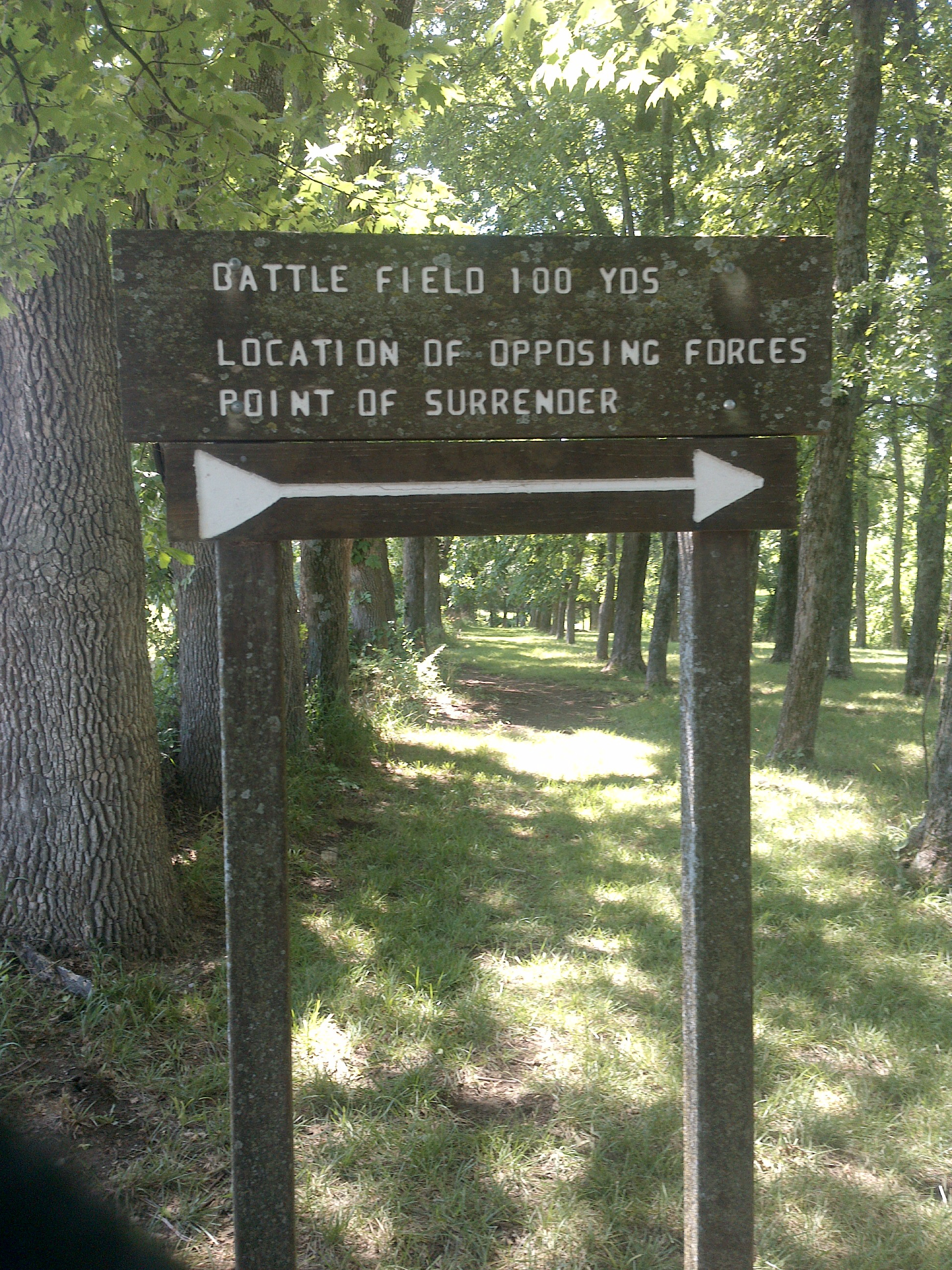
Self-guided tours of the site are available, and the brochure explains the history of the battle with nine stops from Pate’s position, the point of surrender, John Brown’s position and more. Free guided tours hosted every Saturday and Sunday at 1 pm through the third weekend of October.

Also linked to the shorter self-guided tour path is a nature trail and mowed grass trails through a prairie restoration area. It’s a pleasant walk through a place of huge historical significance, and the trails are well taken care of and easy to follow with signs on the nature trail identifying different plants and trees.

I always find it to be a bit odd to walk through a battlefield. As you would imagine, over 150 years later, other than the signs pointing out the pivotal moments of the battle, there is no sign that anything had ever happened there, much less something that helped kick off a war that changed the shape of America forever. It’s a quiet place, or at least it seems as though it would be on most days not during the guided tours, and I had the place to myself.

I always kind of expect to feel the weight of history in places like these. To somehow connect with the ones who crossed through in covered wagons or were prepared to die fighting over the issue of slavery. I never quite feel what I think that I should, which is silly since there is no “right” way to feel, but I think the best that can be done is to get out and go to places like these. To pay respect to what happened there by visiting and walking the trails and by appreciating the space that it is now. Walking the trails at Black Jack Battlefield is a way to connect with the simple, natural world of the prairie and with the complicated history of not just the state of Kansas, but with the nation, and there’s not a lot of places where you can do that.

If you go:

Open from dawn to dusk, 365 days a year

Free

163 E. 2000 Road
Wellsville, KS 66092

Kansas Rail Trails: Interview with Clark Coan

Rail Trails of Kansas

In the 1960s and 1970s, railroad tracks were abandoned across the country, and now, long stretches of former rail tracks have been, or will be, turned into trails.

And in Kansas, the rail-trail conversion and creation process has resulted in over 100 miles of usable trail throughout the state with 100+ either in the concept or project stage. See above for a map of the current and proposed trails.

The longest trail in the state will be the 117 mile Flint Hills Nature Trail, and with a $2.4 million grant, by 2014, it should be completed between Osawatomie to Herington. It will also connect up to the completed and open Prairie Spirit Trail in Ottawa, which runs between Ottawa to Iola and connects to the Southwind Rail Trail, which runs between Iola to Humboldt.

The Flint Hills Nature Trail also links up with the 300+ mile Katy Trail in Missouri via the Indian Creek Streamway Trail and Blue River Trail in the Kansas City area.

Making these trails is a huge undertaking. Planning out the location and getting funding, clearing brush and installing crushed limestone, then maintaining the trail – it’s a big job, and the work is primarily volunteer. One non-profit converting these former railways into trails for foot, bike, and horse traffic, is the Kanza Rail-Trails Conservancy.

Prairie Spirit Trail

On the Prairie Spirit Trail

Former Director of Development at Kanza Rail-Trails Conservancy, Clark Coan agreed to answer a few of our questions about the Kansas rail-trails.

Kansas Trail Guide: When did the rail to trail conversion start in Kansas?

Clark: The Rails-to-Trails Coalition of Kansas began working on railbanking the Landon Trail in 1987.

Kansas Trail Guide: How many volunteer hours does it take to create a rail-trail?

Clark: It depends upon the length of the trail. The longer the trail, the longer it takes. Funding is the main thing which slows up development. Generally, it takes 1,000s of volunteer hours to complete a trail.

Kansas Trail Guide: Is there a trail or part of a trail that’s a personal favorite to walk or ride?

Clark: I guess my favorite right now is riding the Flint Hills Nature Trail from Rantoul to Osawatomie. It has a tree canopy and goes along bluffs towering above the Marias Des Cygnes River.

Kansas Trail Guide: Is there anything that most people don’t realize about the rails-to-trails program in Kansas that they should know about?

Clark: Many Kansans don’t know they exist but they are gradually being discovered. They allow Kansans to have adventures close to home.

Kansas Trail Guide: What is the historical significance of the rail-trails?

Clark: The railroads helped open up the West to settlement. Towns sprung up along railroads and settlers rode the trains to their new homes. The rail lines generally followed historical trails such as the Santa Fe Trail which typically followed Indian trails.

Kansas Trail Guide: What do you feel is the impact of the rail trails on Kansas tourism?

Clark: Tourism from rail-trails can help small towns survive. Trail users need food, gas, lodging and souvenirs. The boost to a small town’s economy may help it stay alive.

Crooked Knee Horse Trail at Melvern Lake

Today on the schedule for trails was the Orange Loop of the Crooked Knee Horse Trail, and it couldn’t have been a better day for it. Temperatures didn’t get over the mid-80’s, and there was a slight breeze. The trailhead is at the Eisenhower State Park on the north side of Melvern Lake, and it’s maintained well, has good signs, and since much of it is exposed, it has some great views out over the prairie, and some pretty beautiful wildflowers. Here are some of the photos I got along the trail:

Interview with Roger of Tailwind Cyclists in Pittsburg

The rolling hills of southeastern Kansas around Pittsburg are perfect for mountain bike trails. I checked in by email with Roger Lomshek, owner of Tailwind Cyclists, which has you covered for all your cycling & outdoor needs, for his recommendations and thoughts on the Pittsburg area trails.

Kansas Trail Guide: What are the best trails in the Pittsburg area for mountain bikers and why?

Roger: We have three trails that offer a mix of flavors for riders.

The 23rd Street Bike Park is in the middle of town 6 blocks east of Broadway on 23rd ST! The bike park has a mix of roller coaster twisty singletrack with lots of short steep 10 foot tall hills. It also has a dirt jumping track with plans to add a trials riding area and pump track. While some areas are beyond the beginner rider there is almost always an easy detour and you’re never more than a half mile from the road.

One of the features at the 23rd Street Bike Park in Pittsburg

One of the features at the 23rd Street Bike Park in Pittsburg

Wilderness Park is at the far north edge of Pittsburg 1/2 mile west of Hwy 69 on McKay ST. The front half has gravel bike & walking paths that are great for beginner riders and families while the back half is a tangle of singletrack trails in heavily wooded hills.

Farlington Lake (Crawford State Park) is 10 miles north of Girard, KS on Hwy 7 (25 miles northwest from Pittsburg). A paved 6 mile road circles the lake while a nearly 8 mile singletrack trail rolls through the woodland around the lake. The singletrack trail has some very difficult sections and overall I would list it as an intermediate trail that is not for beginners.

Kansas Trail Guide: How many volunteer hours does it take to maintain the trails and how many trails does your shop take care of?

Roger: Tailwind Cyclists and our crew of volunteer trail workers maintains all 3 trail networks in our area totaling about 15 miles of trails. We usually devote at least a weekend every other month to trail maintenance and sometimes smaller half day sessions as needed.

Kansas Trail Guide: Are there areas for beginners and experts?

Roger: All three trails offer challenges for expert riders while the 23rd Street Bike Park and Wilderness Park have some beginner friendly portions.

Kansas Trail Guide: Are there any organized trail rides?

Roger: Tailwind Cyclists hosts a Thursday night mountain bike ride that leaves the shop at 6:30 PM during daylight savings time. We also do occasional road trips to further away trails on weekends. Call the shop at 620-231-2212 for details.

Kansas Trail Guide: What gear can people purchase at your shop?

Roger: We sell a wide variety of cycling accessories plus the bikes themselves and can get camping and outdoor gear as well.

Kansas Trail Guide: What do you think makes the Pittsburg area special for mountain bikers?

Roger: The people who ride! We have a great group of riders that make every trail ride fun.

Night hiking

With the heat of summer bearing down, it’s time to think about one of my favorite times to hike.  At night!  A night hike is a totally different experience than during the day and a familiar trail can be totally transformed just by venturing out after sunset.

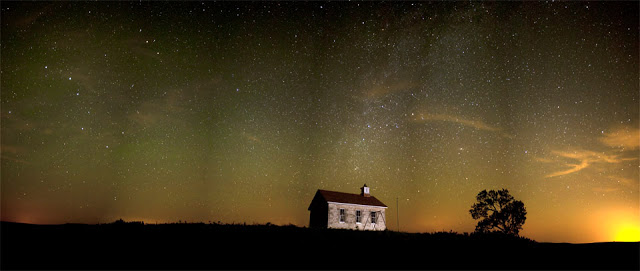
One of my all-time favorite places to hike is the Tallgrass Prairie Preserve near Strong City, KS.  The miles of trails that traverse the rolling hills of pristine tallgrass prairie are open 24-hours a day which makes it the perfect spot for hiking after dark.  While star-gazing is a sublime past-time during night-hiking, the blanket of darkness also heightens the other senses.  Listen for the sounds of the cicadas during the summer and the calls of the barred owl along riparian woodlands.  Take a blanket and hike to a hilltop to watch the stars go by.

Lower Fox Creek School

Lower Fox Creek School
Photo by Andy Nelson

When hiking at night, a few tips will help you to have a pleasant and safe experience.

1. Night hiking probably isn’t the best time to start exploring unfamiliar territory.  Stick to well established trails that you have hiked during the day.

2. Even if the moon is full, a flashlight with extra batteries is essential gear to help with route-finding.  A red filter on your light will help preserve your night-vision.

3. Always hike in a group when venturing out at night.  The foremost reason being that there’s always more fun to be had with several people joining the adventure but it’s also good to have a companion nearby should any mishaps occur.

So if you don’t want to awake at a dreadful hour to beat the summer heat, just wait until the shadows grow long, gather your closest friends, and hit the trails.