Hazards on the trail: Ticks

Generally, getting out on the trail is fun, but there are a few things to make sure you’re aware of to keep your trail experience a good one. First one we’ll be looking into – ticks.

So we’re in the midst of tick season. They’re most active from about April to September, and this year in Kansas, since it’s been particularly dry, they’re out in full force.  While they can carry diseases like Lyme disease and Rocky Mountain spotted fever,  they’re relatively easy to deal with if you know what to do.

Prevent the bite: These little buggers DSC05680(and they are little!) while latch onto you as you walk through grass and underbrush. Walking in the center of the trail can often help with this, but some of the trails in Kansas have some higher grass or leaf litter that can’t be avoided. Wear long pants and ignore all concerns of fashion or style and tuck your pant legs into your socks. The less bare skin you leave for the ticks, the better.

Ticks get on you near your feet and lower legs, so that’s where to keep an eye out first. If you’re walking in or near high grass, do a visual scan every so often and flick off any ticks before they have the opportunity to find a place on your skin to bite. Trying to smash them won’t work like smacking a mosquito, so make sure you pull them off your skin or clothes and get rid of them.

Spraying with DEET is more effective for bugs like mosquitoes and flies; permethrin has been known to be more effective as a tick repellent, and it can only be used on fabric. So you can pre-treat clothing with a permethrin spray (takes 2-4 hours to dry so plan ahead) or buy clothing already treated with it.

If you get bitten: First thing to know, and which was particularly reassuring to me the first time I heard it, is that (a) not only do not all ticks carry disease but (b) it takes several hours after a tick has bitten to transmit a disease. So if you do a thorough tick check after being out on the trail, looking everywhere and paying particular attention to “tight” places, you can have a high chance of avoiding disease even if a tick has bitten. Check once, then check again. Don’t think a shower will get them off – you may have to pluck them off.

Finding a tick that has bitten in can be unnerving, and there are lots of tales about how to best remove them: from smothering them with vaseline or using a hot match. The quickest and best way, however, and the one that’s recommended by the CDC and any and all medical professionals I’ve asked (limited, I know, as it was two registered nurses in my family), is to use tweezers. Place the tweezers around the tick as close to your skin as possible and pull it firmly away from you, removing the head along with the tick’s body. Then treating the spot with a bit of rubbing alcohol or antibiotic ointment won’t hurt.

If you get a red rash or a fever in the days or weeks after getting bitten by a tick, check in with your doctor and make sure to tell them about your tick bite and let them know where you were on the trail when you were bitten.

Your opinion wanted on the Kansas parks

Sundown - February 24, 2010 - Kansas City

Sundown – February 24, 2010 – Kansas City (Photo credit: CoolValley)


The Kansas Department of Wildlife, Parks, and Tourism is looking for your input on Kansas parks. If you go to http://ksoutdoorrecreation.blogspot.com/, they’re looking for specific comments and there’s also a survey that you can complete.

Four topics will be covered:
  • June 21- July 4 TOPIC:  Which outdoor recreation facilities are most in need of renovation or replacement at state and federal parks in Kansas to best enhance outdoor recreation experiences?  Specific examples are welcomed.
  • July 5 – July 18. TOPIC:  Share a story of a meaningful outdoor recreation experience that you or your family had in Kansas and how the site where that experience took place contributed.
  • July 19 – Aug 1. TOPIC:  Which of the following local outdoor recreation experiences would you like most to be within walking distance of your home (if you live in town)?   Trails/picnic areas/sports venues/natural areas/playgrounds
  • Aug 2 – Aug 15 TOPIC:  Improved access to natural outdoor experiences, particularly those water based, is important for urban dwellers.  Please provide suggestions on how this can best be achieved and examples of success stories.

Your opinions matter and will help shape the direction of the state’s Outdoor Recreation Plan!

Finding and cooking wild Kansas edible mushrooms

We’re in the midst of mushroom season in Kansas, and they’re one of our favorite wild plants on the trail.

If you’re in Lawrence the second Saturday of every month from April to October, you can go out with the Kaw Valley Mycological Society and hunt for mushrooms. The following Wednesday, you can check out what was collected and learn more about the mushrooms of Kansas.

And if you want to head out on your own, here are 5 Kansas mushrooms you can eat with cooking recommendations.

As a disclaimer, mushrooms can be toxic and easily confused with many that look alike, and this should not be used as an authoritative identification guide. Be confident that you know what you have before biting into a wild mushroom. When in doubt, throw it out. Use a field guide, like the one published by University Press of Kansas to help you.

Morel mushroom. Photo by Michael Hodge

Morel mushroom. Photo by Michael Hodge

Morels

One of the most popular and well-known wild mushrooms in Kansas as well as one of the first of the season, morels can be found in wooded areas, particularly near creek beds and dead and dying trees. The surface will be deeply pitted and the inside will be hollow.

To cook: Clean them by soaking them in cool, slightly salty water and rinse them thoroughly.

Then saute in butter or olive oil for about 5-7 minutes. For a gourmet twist on the flavor, saute some minced garlic for a few minutes in the olive oil before adding the mushrooms.

Chanterelle

Chanterelle. Photo by Ole Husby

Chanterelle. Photo by Ole Husby

Frequently found in forests near mature, living trees and growing out of the ground (not from the trees themselves),  these mushrooms are a uniform bright yellow or gold color with wavy tops and smell fruity – a bit like apricots. You can typically find them in Kansas from mid-June to October.

To cook: Popular with gourmet chefs around the world, chanterelles need to be carefully cleaned to remove dirt with a small brush or cloth, using water if necessary. Avoid soaking. Eaten raw, they have a peppery aftertaste and can be used in green salads, but they taste better cooked.

Saute them in butter or oil for a few minutes – they should be lightly browned and still firm and they can then be paired with sauted green beans or with scrambled eggs and chives. They’re also a good topping for grilled chicken and steak.

If you end up with a lot of chanterelles and you can’t cook them up in a few days, you can dry them in the oven (be prepared for a strong smell in the kitchen) overnight on low heat.

Maitake. Photo by Ben Harwood

Maitake. Photo by Ben Harwood

Maitake or Hen of the Woods

Growing along the base of oak trees, these mushrooms are characterized by their overlapping growth. A pale or dark brown on top and white underneath without gills, they have wide, flat fronds and you can find them in Kansas in the late summer and fall.

To cook: Take the time to thoroughly clean the mushrooms, and remove the core of the stem before cooking.

Pan roast them in olive oil for a few minutes after they turn golden brown and then add fresh rosemary and a dab of butter and some salt and pepper and cook for about another minute. Drain off any excess oil before serving them up.

They can be frozen fresh, but don’t thaw them before cooking. Toss them straight into the pan from the freezer.

Oysters

Oyster. Photo by Dominic Alves

Oyster. Photo by Dominic Alves

These white or gray mushrooms grow only on trees, often on elms or willows. It has a broad, fan or oyster shaped cap and firm white flesh. They can smell a bit like anise if harvested from a tree. There are some lookalikes, so be careful. You can find them in Kansas in late October and November.

To cook: Cut off the stem and run them under water quickly to flush out any bugs or dirt in the underside crevices. These mushrooms are ideal in stir fries as they cook quickly.

Cook them in hot sesame or peanut oil with minced garlic and ginger for a few minutes, and then add some chicken broth and soy sauce and simmer for a few more minutes, and then serve over rice.

They can also be dried and stored – they dehydrate quickly. Rehydrate by soaking them in boiling water for 15 minutes.

Black trumpet. Photo by hr.icio

Black trumpet. Photo by hr.icio

Black trumpet

With a funnel like shape, these small gray and black mushrooms can be found in moss and near oak trees and other hardwood trees.  They have a fruity scent, and they are close relatives to chanterelles. Find them in Kansas through summer and early autumn.

To cook: Clean by dunking them several times in cold water and squeezing them dry.

Saute in butter and then serve them with cooked pasta and topped with parmesan cheese and fresh chives.


What are your favorite wild Kansas mushrooms? Share those along with any favorite recipes in the comments below!

Favorite hiking and biking trails around Salina

Salina, Kansas is hosting their annual Smoky Hill River Festival this weekend.  Bonus – along with the art, culture, and food of the festival, the city has some fun trails. Here are our favorites, some of which will be featured in our book.

For a view

Hike up to the top of Indian Rock. Along the Smoky Hill River, the park was named for its location as a Native American battle. The bluff is one of the city’s highest points, and the trails wind through wooded areas and open prairie with more moderate hiking than the surrounding plains.  Watch out for flying frisbees – the park is popular with disc golfers.

For a long(er) workout

Walk, run, or bike from the north end of Bill Burke Park up to the flood control levee south to Magnolia Street and back – round trip 6.2 miles of mostly flat, wide trail.

For families

Lakewood Park has a total of 2.25 miles of easy to walk trail, including a 13 station interpretive nature trail, a butterfly garden, and lots of birds.

Konza Prairie annual wildflower walk – Sunday, June 2

Konza Prairie wildflowers

From 6:30 to 9:00pm on Sunday, June 2, the Kansas Native Plant Society will be hosting its annual wildflower walk. Naturalists will take visitors along the Butterfly Hill Trail, which isn’t normally open to the public, and they will point out and identify the wild variety of native wildflowers that can be found in the prairie. Bring bug spray and comfortable walking shoes and, of course, your camera as you learn more about the native plants of Kansas and marvel at the vistas of the Konza Prairie (which will be highlighted in our Kansas Trails guidebook).

Cost: $10 per person. All proceeds go to Konza Environmental Education Program, whose mission is to: “enhance the understanding of the ecology of the tallgrass prairie ecosystem; increase understanding of the process and value of science; and increase public appreciation for the importance of scientific research as a foundation for sound grassland conservation and management.”

Where: Meet at Konza Prairie Biological Station, 100 Konza Prairie Lane

Edible wild plants on the trail

While there is certainly a place for trail mix and beef jerky in your pack, a little bit of culinary adventure and variety can be found growing right alongside most trails in Kansas. With some basic botanical knowledge and common sense there are many plants that will serve as a veritable outdoor pantry for your next time on the trail. While outdoors, I’ve thoroughly enjoyed sampling the following wild plants:

1. Mulberries. Planted and eaten by early settlers and Native Americans, mulberries are one of my favorite wild snacks. The sweet fruits ripen in mid-summer and the juicy purple berries make a terrific snack while on the trail. The berries can also be used for pies and jams, but they’re so good right off the tree that I’ve somehow never managed to bring home enough to preserve.

2. Sandhill plums. Commonly found in thickets throughout tallgrass and mixed-grass prairies of eastern and central Kansas, wild plums are a delight to eat during late summer. When the berries are fully ripe, the slightly tart plum fruits are also a favorite food of many species of wildlife.

Morel Mushrooms

Freshly picked morel mushrooms

3. Morel mushrooms. Morels are a highly sought after delicacy and many “mushroom hunters” scour woodlands of central and eastern Kansas in the early spring in search of the delicious morel. Morels appear around the time that redbuds bloom and are only present for a few weeks in any given area.

The distinctive wrinkled caps of the mushroom and the hollow stalk make them easy to distinguish from other species but they should not be eaten unless you are absolutely sure that they are indeed morels. While the other plants on this list can be eaten raw, these mushrooms should be cooked before consumption. Personally, I’m partial to sauteeing them in a little butter with a hint of garlic.

4. Wild rose. The beautiful wild rose grows state-wide in prairie areas of Kansas. The fruits of the wild rose are known as “rose hips” and are extremely high in Vitamin C. They ripen during August and September and can be eaten raw or made into jelly. The flower petals are also edible and make a tasty addition to a spring salad.

5. Yucca. The sharply pointed leaves of this species make it easy to identify and it is common in many areas of central and western Kansas. There are a variety of parts of the yucca plant that were consumed by Native Americans, including the flower stalk, petals, and the immature fruits. While on the trail, try the distinctive white petals for some interesting eating.

These species are common throughout Kansas and fairly easy to identify, but always make certain that you are 100% certain of the correct identification (especially with mushrooms) before eating any of these plants while on the trail. If these plants leave you wanting even more, look for additional information in Kelly Kindscher’s authoritative guidebook – Edible Wild Plants of the Prairie published by the University Press of Kansas.

Kansas Trail Map

Looking to find a trail in Kansas near you? This interactive map provides trailhead locations, pictures, and directions to help you find a trail that’s perfect for you. As we keep hiking we’ll add more trails for your enjoyment!

Hiking with bison

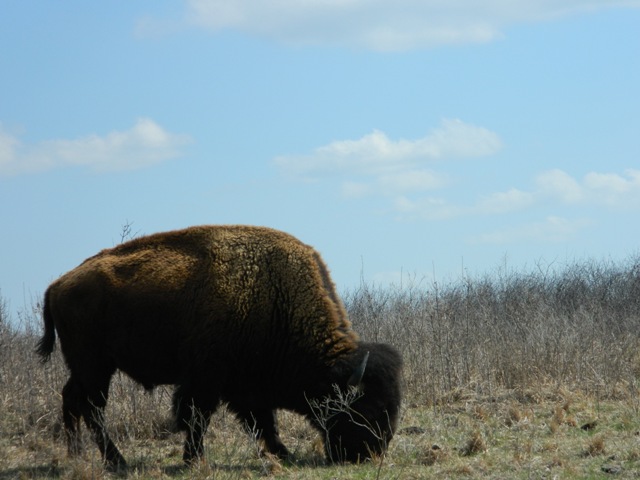
The chance to get up close and personal with large free-ranging bison is an unforgettable experience.  There are a few places to observe bison in Kansas; including the Sandsage Bison Range near Garden City, the Konza Prairie south of Manhattan, and the Tallgrass Prairie Preserve in the heart of the Flint Hills.  However, one of my all-time favorite locations to see these shaggy beasts is at Maxwell Wildlife Refuge just north of Canton.  Maxwell maintains a herd of around 200 bison and 50 elk, making this the only public area in the state where you can observe both of these species.  The really cool thing about Maxwell is that the access road for the state fishing lake runs right through the middle of the bison pasture.  A leisurely drive will easily give you the chance to see large bison bulls and cow/calf groups scattered throughout the mixed-grass prairie hills.

Bison grazing at Maxwell Wildlife Refuge

Bison grazing at Maxwell Wildlife Refuge

If you have binoculars, climb to the top of the wildlife observation tower which lets you look out over almost the entire area and really see the wildlife that’s out there.  We drove through the area last weekend and were lucky enough to see part of the elk herd and have several bison walk within 10-feet of our vehicle (which was about as close as we would have liked them to be).

This kind of a viewing experience would cause a traffic jam and photography frenzy at Yellowstone, but we virtually had the whole place to ourselves.  It’s easy enough to see bison and elk most days, but to see even more of the refuge and find out a little more about the natural history of the area you can also reserve a backcountry tram tour through the Friends of Maxwell Group website.

After checking out the wildlife we took the family on a little hike along the nature trail by the state fishing lake.  The woods were starting to show signs of spring with buds swelling and getting ready to burst at any time.  We didn’t see any morels, but saw several people out on the hunt.  The trail was a nice short hike through the woods by the lake with a loop option to add a little variety.  The highlight for the kids was definitely the stream at the end of the trail (and the trail snacks of course).  All said, it made for an afternoon of good hiking and great wildlife-viewing!

Kansas by numbers

8 feet – the height grasses can reach in the tallgrass prairie

Author Jonathan Conard with his daughter.

Author Jonathan Conard with his daughter at the highest point in Kansas

11 physiographic regions

14 mph average wind speed in Dodge City, Kansas’ windiest city

24 state parks

24 endangered species

65 feet – the depth of Milford Lake, the state’s largest lake

300 bison (approximately) in the herd on the Konza Prairie

467 recorded bird species

680 feet above sea level – Verdigris River, the lowest point in the state

4,039 feet above sea level – the height of Mount Sunflower, the highest point in  the state